Malawi’s five water boards are still losing billions of kwacha through non-revenue water (NRW), which averaged 35.3 percent in 2024, according to a government report.
This means the sector is only selling 64.7 percent of its pumped water, which translates to lost annual revenue of between K66 billion and K70 billion in 2024 from K60 billion in 2023 based on the 10 percent average tariff increment that was effected in 2024.
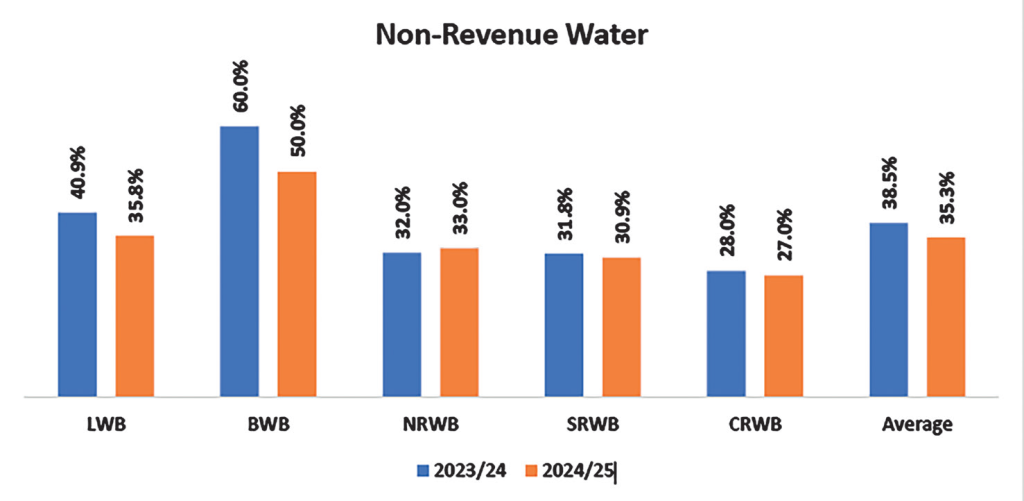
According to the government Annual Economic Report for 2025, none of the water boards met the internationally recommended level of 25 percent NRW with others registering as high as 50 percent NRW due to factors such as aging pipes, poor maintenance and inaccurate billing and meter readings.
Reads part of the report: “The NRW is attributed to factors such as physical leakages in the distribution system due to pipe breakages resulting from construction works and other project activities, aging and variations in pressure, unauthorised water use, vandalism of water supply plants, and inaccuracies in billing or meter readings.”
Blantyre Water Board (BWB) recorded the highest NRW at 50 percent followed by Lilongwe Water Board (LWB) at 35.8 percent, Northern Region Water Board (NRWB) 33 percent, Southern Region Water Board (SRWB) 30.9 percent while Central Region Water Board (CRWB) was the least at 27 percent.
The report, however, notes that other boards are now implementing District Metered Area Management System, which is reducing the NRW.
From the available data, most water boards are also struggling with debt collection as the ‘debtor days’—average number of days it takes for customers to settle their bills—averaged 82 from the recommended 60 days, with SRWB recording as high as 137.
In an interview, financial expert Brian Kampanje said NRW has the potential to force water boards to rely on few customers who are charged higher tariffs in a bid to meet the operational costs and this defeats the notion that water is life.
He observed that NRW also inhibits organic growth, noting water boards usually make losses and have no surplus to invest in new systems that include pipes, meters and tanks.
Said Kampanje: “This inhibits expansion projects so they fail to supply potable water to the rapidly growing population.
“The water boards end up draining public funds through increased funding from Treasury instead of being self-sustainable. Public resources could have been spared and used in other important public services if the non-revenue water was controlled.”
In a separate interview, Consumers Association of Malawi executive director John Kapito said consumers are forced to carry the burden of the NRW on behalf of the failed internal systems as most affected boards resort to water tariff hikes once government refuses to bail them out.
“Unfortunately these non-revenue waters are passed on to innocent consumers, making access to water expensive,” he said.
In an interview, Ministry of Water and Sanitation spokesperson James Kumwenda said the issue of NRW could be well clarified by individual water boards, saying the ministry’s policy recommends the 25 percent limit, but individual boards may have different challenges and strategies.
Meanwhile, BWB chief executive officer Robert Hanjahanja attributed the board’s high non-revenue water to aging infrastructure.
But he was quick to say the board is implementing a $150 million (about K260 billion) World Bank project to overhaul its infrastructure.
“As you know BWB is the oldest water board established in 1929 and most of the infrastructure is not effective. We have a $150 million grant and through the project, we are replacing all the old pipes. We expect phase two to target the Limbe area. We expect to lower the non-revenue water to 25 percent by 2029,” Hanjahanja said.